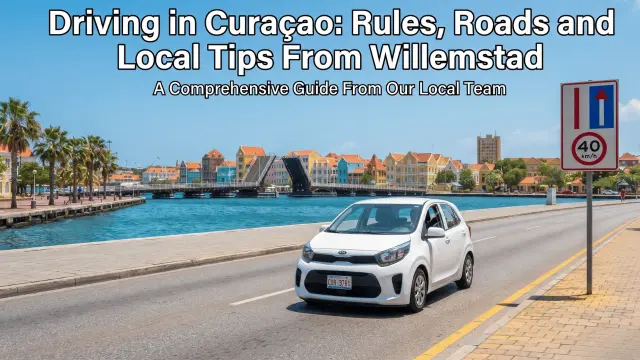
Quick answer: Curaçao drives on the right, the same side as the US, Canada and the Netherlands. By law the speed limit is 40 km/h in built-up areas and 60 km/h outside them. Right turns on a red light are not allowed. Roundabouts and T-junctions cause most visitor mix-ups, so read those sections first.
Bon bini (welcome) to Curaçao. Driving in Curaçao is straightforward for most visitors. The main roads around Willemstad and the resort areas are paved, and traffic thins out quickly once you leave town.
The details are what trip people up. Road signs follow Dutch standards, some junction rules differ from North America, and speed and alcohol limits are often quoted wrongly. We checked every rule below against the Wegenverkeersverordening, the island’s road traffic ordinance, and against current travel advice from the US, Canada and the UK. We are locally owned and run from Willemstad, and have been since 2015. We wrote this guide for visitors who plan to drive here.
What Side of the Road Does Curaçao Drive On?
Curaçao drives on the right, with the steering wheel on the left. The Curaçao driving side matches the US, Canada and the Netherlands (ANWB).
If you drive on the left at home
For UK and other left-side drivers, driving in Curaçao means switching sides. Most mix-ups happen on the first day: pulling out of a parking space, turning at a junction and entering a roundabout. Go slowly until the right-hand habit settles, and keep your first roundabout simple.
If you come from the US, Canada or the Netherlands
The side is familiar. The road signs follow Dutch standards, though, and the Government of Canada advises visitors to review them before they drive. Junction and roundabout rules also differ from North America, so read the right-of-way section below.
Driving in Curaçao Requirements: Can Tourists Drive, and Do You Need an International Driving Permit?
Yes, tourists can drive. A valid driving licence from your home country works if it uses the Latin alphabet, and our team does not ask visitors for an International Driving Permit (IDP). You can confirm this on our FAQ page.
Some governments still suggest carrying a permit:
- Canada accepts Canadian licences and advises carrying an IDP as well (Government of Canada).
- United Kingdom: a UK photocard licence can be used. If you still hold a paper licence, you may need to exchange it or get the right version of an IDP (UK FCDO).
Carry your licence and your passport, or a copy of it. Canada’s advice notes that local law requires you to have valid ID on you at all times.
The road traffic ordinance requires a valid licence to drive a motor vehicle (Art. 102). It gives no validity period for international permits, so we point you to the travel advice above for your own country.
Curaçao Driving Rules at a Glance
These are the rules visitors ask about most. Article numbers refer to the Wegenverkeersverordening Curaçao 2000.
| Rule | What it says | Source |
|---|---|---|
| Side of the road | Right | ANWB |
| Speed, built-up areas | 40 km/h for cars | Ordinance, Art. 46 |
| Speed, outside built-up areas | 60 km/h for cars | Ordinance, Art. 47 |
| Motorway stretches | 40 km/h minimum, 80 km/h maximum | Ordinance, Arts. 46–47 |
| Alcohol | Limit: 0.5 mg per ml of blood (0.05%) or 220 µg per litre of breath | Ordinance, Art. 22 |
| Phone | Handheld use is prohibited; hands-free is allowed | Ordinance, Art. 29 |
| Seat belts | The driver and passengers next to a door must wear the belt | Ordinance, Art. 78 |
| Children | Under 12 and shorter than 1.50 m: approved child restraint | Ordinance, Art. 78 |
| Headlights | Dipped beam at night and when visibility is seriously reduced | Ordinance, Arts. 57–66 |
| Right turn on red | Not allowed | Canada, US State Department |
| Stopping and parking | No stopping beside a continuous yellow line; no parking beside a broken yellow line | Ordinance, Arts. 49–50 |
| Tolls | None | Around Curaçao Rental |
Why the Numbers for Driving in Curaçao Vary
Quoted figures vary widely: urban limits from 30 to 60 km/h, rural limits from 60 to 100 km/h, and child-seat ages that differ from one source to the next. Some even claim Curaçao has no alcohol limit. The ordinance sets the numbers in the table above. Its consolidated text dates from 2013, and a 2025 decree restates a separate cap: moped-type vehicles may not exceed 40 km/h. If a posted sign shows a lower limit, follow the sign.
What Are the Speed Limits in Curaçao?
For cars, the limit is 40 km/h (about 25 mph) in built-up areas and 60 km/h (about 37 mph) outside them. Motorway-type stretches carry a posted maximum of 80 km/h (about 50 mph) (Ordinance, Arts. 46–47).
Mopeds have lower limits: 30 km/h in built-up areas and 40 km/h outside them. Keep to the limits when driving in Curaçao, even when others do not. If a driver tailgates you, hold a steady speed and let them pass.
Can You Turn Right on a Red Light in Curaçao?
No. Wait for green. Both the Government of Canada and the US State Department list the ban on right turns at red lights in their travel advice.
The ordinance says red means stop, and yellow means stop unless stopping is no longer reasonably possible (Art. 8). Some local drivers still go through just after the light turns red, so look both ways before you pull away on green (naarcuracao.com).
Who Has Right of Way at Roundabouts and T-Junctions?
Right of way is where most visitors go wrong when driving in Curaçao. In 2022, the Safe Traffic Curaçao foundation (VVC) said many tourists assume the driver on the right always has priority (Curaçao Chronicle). At T-junctions, that is wrong.
At T-junctions
The driver on the road that ends gives way to traffic on the through road, from both sides. Priority from the right does not apply here (Ordinance, Art. 41(2)(b)).
At equal intersections and on unpaved roads
Where nothing sets priority, give way to traffic from the right (Art. 41(1)). A driver on an unpaved road gives way to a driver on a paved road (Art. 41(2)(a)). Painted triangles across the road, called shark teeth, mean give way to the crossing road (Art. 17). They can fade, so do not assume priority when markings are unclear (ANWB).
At roundabouts
The ordinance has no roundabout-specific rule. The ANWB advises giving way to traffic already on the circle where signs or markings show it. Where nothing is marked, traffic from the right has priority.
In February 2026, the Common Court of Justice ruled on a collision at the Plasa Hariri roundabout. A driver who changes lanes on a roundabout must yield to traffic going straight. A driver in the outer lane who follows the lane markings does not have to yield to inner-lane traffic (Curaçao Chronicle). Pick your lane early and keep to it.
Curaçao’s roundabouts are single-lane designs. Planners are now looking at multi-lane designs like Aruba’s for new roundabouts (Curaçao Chronicle).
At traffic squares
Some junctions look like roundabouts but are verkeerspleinen, or traffic squares, with their own rules. Vehicles may pass on either side there (Ordinance, Arts. 67–68), and VVC says missing signs often leave priority unclear. If you are unsure, slow down and let others go first.
Road Signs You’ll See in Curaçao
Signs for driving in Curaçao follow Dutch standards. Canada and the US both advise visitors to review them before they drive. These markings catch visitors most often:
| Sign or marking | What it means | Source |
|---|---|---|
| Painted triangles across the road (shark teeth) | Give way to traffic on the crossing road | Ordinance, Art. 17 |
| Continuous yellow line at the kerb | No stopping | Ordinance, Art. 49 |
| Broken yellow line at the kerb | No parking | Ordinance, Art. 50 |
| Yellow traffic light | Stop, unless stopping is no longer reasonably possible | Ordinance, Art. 8 |
| Turn-ban signs | Some visitors read them differently from signs at home, so check before you turn around | Curaçao Chronicle |
Road signs can be missing or hard to read at some intersections and roundabouts. Slow down when you cannot tell who has priority.
Is It Safe to Drive in Curaçao, Including at Night?
Yes, with normal care. The US State Department rates Curaçao Level 1, exercise normal precautions (advisory issued 9 September 2026). The Government of Canada says major roads are in good condition but many drivers do not follow traffic laws. Police record about 11,000 accidents a year (Curaçao Chronicle).
Watch for scooters and motorcycles, whose riders may not follow the rules, and take extra care at intersections and roundabouts.
Driving in Curaçao at night is fine on lit main roads. Street lighting is limited elsewhere, and potholes are harder to see after dark (US State Department). On the Westpunt road, some local drivers overtake fast and unsafely after dark. Do not overtake yourself. If an oncoming car enters your lane, move toward the shoulder (naarcuracao.com).
How Do Police Enforce Traffic Rules in Curaçao?
Checks are becoming more frequent. On 22 December 2024, Police Chief Jules Ilario launched the Kita Tur road safety campaign and said traffic checks would continue after it ended. Drivers without a valid inspection certificate or insurance get a ticket. Vehicles with missing inspection papers, missing insurance or unpaid road tax can be removed from the road (Curaçao Chronicle).
Keep your licence and ID within reach. The rules for driving in Curaçao also cover alcohol: the limit is 0.5 mg per ml of blood (Ordinance, Art. 22). Parking violations can bring a wheel clamp (naarcuracao.com).
Animals, Potholes and Unpaved Roads: What to Expect
- Animals. Goats cross rural roads (ANWB). The US State Department adds iguanas and donkeys. In the quiet west, watch for goats and iguanas.
- Potholes. Drivers swerving around them cause many accidents (ANWB). Puddles can hide deep ones, so slow down and go around them.
- Rain. Roads turn slippery, especially where dust and sand sit on the surface. Brake earlier and leave more distance. The ramps of the Juliana Bridge are slippery when wet (naarcuracao.com).
- Unpaved tracks. Some tracks to remote western beaches, such as Banda Bou, are unpaved (Around Curaçao Rental FAQ).
- Road quality. The main route from Willemstad to Westpunt is in good condition. Secondary roads are of lower quality (ANWB).
The fix is the same each time: slow down, hold your line and leave extra room.
Where Most Accidents Happen in Curaçao
Forensys keeps the island’s accident registry for all insurers. Its 2023 figures, reported by the Curaçao Chronicle in July 2024, show where crashes cluster for anyone driving in Curaçao.
| Road | Accidents in 2023 | Length |
|---|---|---|
| Schottegatweg (four segments) | 868 | Over 10 km |
| Caracasbaaiweg | 422 | Nearly 13 km |
| FD Rooseveltweg | 390 | Nearly 7 km |
| Winston Churchillweg | 308 | 3 km |
The island recorded more than 11,000 accidents that year, and the 20 worst roads accounted for 3,858, nearly 35 percent. The counts do not adjust for how much traffic each road carries, so they do not prove which road is least safe. The Westpunt road also has a high accident rate (naarcuracao.com).
Do You Need GPS, and How Does Fuel Payment Work?
Download offline maps before you arrive. Street signs go missing, and some addresses end in z/n, short for zonder nummer, which is Dutch for without a number. A phone map that works without mobile data covers both problems (naarcuracao.com).
At fuel stations you usually pay before you pump. Tell the attendant how much you want and collect your change afterwards. Stations get sparser in the quiet west, so fill up in Willemstad before you head toward Westpunt (Around Curaçao Rental FAQ).
Parking in Curaçao
In Punda and Otrobanda, parking has been paid since October 2024. It runs Monday to Saturday from 8:00 to 18:00 and is free on Sundays and holidays. You can pay with coins, the Flowbird app or a ticket from an attendant, and violations bring a wheel clamp (naarcuracao.com). Never park beside a broken yellow line, and never stop beside a continuous one (Ordinance, Arts. 49–50).
Vehicle break-ins are increasing, according to the US State Department. Keep valuables out of sight, and avoid parking lots without attendants or security gates.
What Should You Do After an Accident, and Who Do You Call?
- Check that everyone is safe. If anyone is hurt or in danger, call 911 for the police or 912 for an ambulance.
- Switch on your hazard lights. A stopped vehicle that creates a hazard needs a warning triangle about 30 m behind it, unless the hazard lights are on (Ordinance, Art. 77).
- Stay at the scene until names and vehicle details are exchanged. Anyone driving in Curaçao who leaves after a crash with injury or damage commits an offence (Art. 26).
- Call Forensys on 9233. It keeps the island’s accident registry for insurers and records the scene.
- Take photos of the scene, the plates and the damage.
- Move the car only if it blocks traffic or is unsafe where it stands. Otherwise leave it until Forensys has recorded the scene, because moving it can put insurance cover at risk (naarcuracao.com).
| Number | Who answers | Source |
|---|---|---|
| 911 | Police and fire department | Government of Canada |
| 912 | Ambulance | ANWB |
| 917 | Police, no urgent danger | ANWB |
| 9233 | Forensys, accident reports | Around Curaçao Rental FAQ |
| +5999 461 3282 | Forensys line for tourists | naarcuracao.com |
| 9247 | Wegenwacht Curaçao, breakdown assistance | ANWB |
Your First-Day Checklist for Driving in Curaçao
- Licence and passport (or a copy) in the car.
- Offline map downloaded.
- Seat belts on, and children in approved restraints.
- Phone in a hands-free mount, or out of reach.
- Red light: wait for green, even to turn right.
- T-junction: if your road ends, give way.
- Tank full in Willemstad before you head west.
- Valuables out of sight, and the car in an attended or gated lot.
- 911 and 9233 saved in your phone.
How We Checked This Guide
We last verified this guide on 13 October 2026.
- Rules: the consolidated Wegenverkeersverordening Curaçao 2000 (Landsbesluit of 31 January 2013, A.B. 2013, no. 41 G.T.) and a 2025 decree on moped speed.
- Travel advice: the US State Department, the Government of Canada and the UK Foreign Office.
- Local reporting: the ANWB, naarcuracao.com and the Curaçao Chronicle, which reports Forensys and police figures.
- Our own details: the licence, unpaved-track and fuel points come from our FAQ page.
The consolidated ordinance text shows amendments only through 2010, and we are not lawyers. If you need legal certainty, check the Publicatieblad van Curaçao. We update this guide when the rules change.
Ask Our Team Before You Go
Thinking about driving in Curaçao? Our Road Trips page maps routes across the island, and our Beaches guide flags the unpaved tracks in the west. Questions about the road? Send our team a message on the Contact page. Masha danki (thank you very much) for reading, and drive safe.